

Are you looking for the most accurate ways to distinguish between a genuine and a fake Patek Philippe watch? Zuli Watch is here to help, with 10 detailed inspection methods, from examining the movement to verifying the paperwork. Read this article now to equip yourself with the knowledge to confidently identify an authentic Patek Philippe and avoid unnecessary risks.
Why Is Knowing How to Spot a Fake Patek Philippe Important?
Accurately identifying an authentic Patek Philippe watch is crucial for several reasons.
First, it protects your investment. A genuine Patek Philippe is a significant financial commitment that retains and often appreciates in value over time. In contrast, a fake watch, no matter how well-made, holds no collectible or investment value, posing a substantial financial risk if purchased unknowingly.

Second, it ensures the quality and ownership experience you deserve. An authentic Patek Philippe offers near-perfect precision, the durability of a complex mechanical movement, and a premium wearing experience thanks to its high-quality materials and exquisite finishing. Counterfeits simply cannot replicate these attributes.
Finally, owning and wearing a genuine Patek Philippe maintains your personal reputation and status. Using a counterfeit item can negatively impact your image. Understanding how to differentiate also boosts your confidence when navigating the secondary market or exploring high-quality replica watches offered by Zuli Watch .
Related Articles:
-
Which Country is Patek Philippe From? [Detailed Answer 2025]
-
The Most Expensive Patek Philippe Watch in the World: Record Prices 2025
-
Replacing a Patek Philippe Leather Strap: 5 Tips & 3 Optimal Choices 2025
10+ Detailed Ways to Authenticate a Patek Philippe Watch
To distinguish between a genuine and a fake Patek Philippe, you need to meticulously examine multiple factors. Here are the most effective methods, organized from general observations to detailed inspections:
Check Overall Weight and Feel
This is the initial and most intuitive step to sense a difference.
Genuine Patek Philippe watches typically have a substantial weight, offering a solid and sturdy feel in hand. This is because the brand uses precious materials like 18k gold, platinum, or high-grade stainless steel for both the case and bracelet.
Conversely, fake Patek Philippe watches are often noticeably lighter. They use cheaper materials like low-quality steel or plated alloys, resulting in a flimsy, less substantial feel when held.
Scrutinize the Quality of Case and Bracelet Finishing
Finishing quality is a hallmark of luxury watches, especially Patek Philippe.
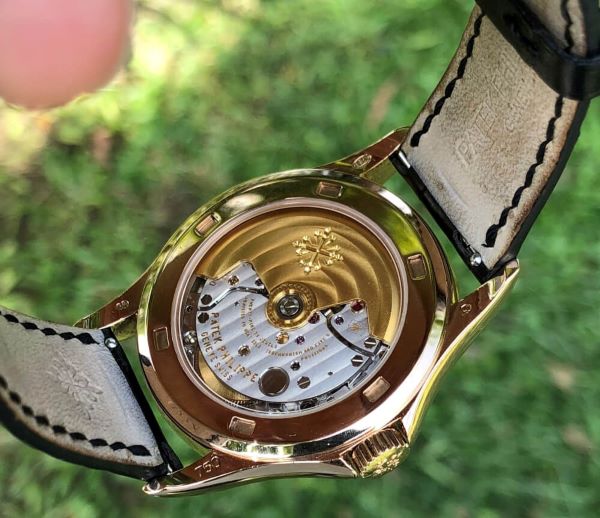
Closely inspect the surfaces of the watch case and bracelet. An authentic watch showcases perfection in every detail: sharp yet smooth bevels, mirror-polished surfaces without blemishes, and uniform, refined brushing.
Fake watches, even high-end Patek Philippe replicas, typically struggle to achieve this level of finishing. You might spot flaws such as rough edges, inconsistent brushing, blotchy polished surfaces, or clunky transitions between different finishing styles. Bracelet links on fakes may also feel loose or overly stiff.
Differentiate Through Dial Details
The dial is the face of the watch and contains many important identification clues.
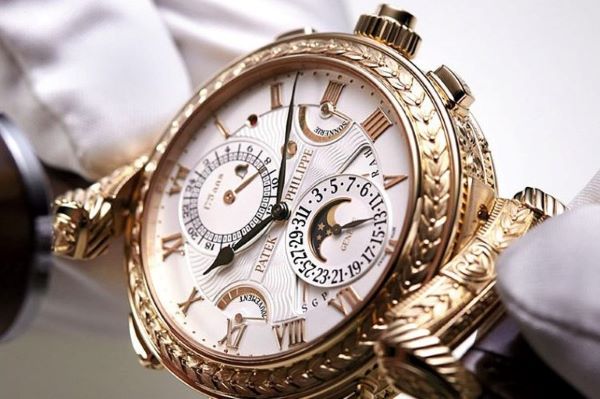
- Indices and Hands: On a genuine watch, the indices and hands are crafted with extreme precision, perfectly balanced, with sharp edges and excellent light reflection.
- Luminescence (Lume): If the watch model features lume, the lume on an authentic piece will be very even, bright in the dark, and retain its glow well, matching the brand’s specified color (usually green or blue).
- Printing and Logo: The “PP” logo or Calatrava Cross symbol, the brand name “PATEK PHILIPPE,” “GENEVE,” and the word “SWISS” at the 6 o’clock position must be extremely crisp, fine, balanced, in the correct characteristic font, and with even spacing.
- Overall Quality: An authentic dial has depth, accurate colors, and intricate textured effects (like Guilloché, Sunburst) executed flawlessly, without any dust particles or fingerprints under the crystal.

Examine the Crown and Clasp
These are frequently interacted-with parts and also display the brand’s identity.
The Calatrava Cross logo is often engraved or embossed on the crown and clasp. On a genuine watch, this logo is very clear, sharp, balanced, and has appropriate depth.
When operating the crown (winding, setting time/date), an authentic crown feels very smooth, precise, and secure. The watch’s clasp (whether folding or pin buckle) is also meticulously finished, opening and closing easily, securely, and safely.
Assess Sapphire Crystal Quality
Most modern Patek Philippe watches use sapphire crystal for the front (and sometimes back).
Genuine sapphire crystal has very high hardness (second only to diamond), providing effective scratch resistance. The crystal must be perfectly transparent, with no ripples or image distortion when viewed from an angle.
Many Patek Philippe models also feature single or double-sided anti-reflective coatings. You can often spot this coating by a subtle blue or purple hue when tilting the crystal under light.
Differentiate by Movement – The Core Element
The movement is the heart and soul of a Patek Philippe watch and the most challenging part to counterfeit. If possible, request to have the case back opened or observe through a sapphire display back (if present).
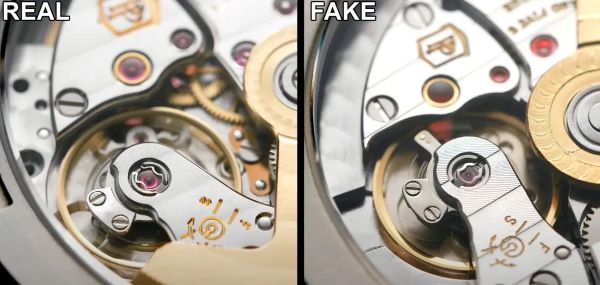
An authentic Patek Philippe movement is a mechanical masterpiece with supreme finishing, adhering to the stringent standards of the Patek Philippe Seal (or Geneva Seal for older models). You’ll observe exquisitely decorated components:
- Geneva stripes or perlage patterns on bridges and main plates.
- Beveled and polished edges of movement bridges.
- Polished or blued screw heads.
- Extremely crisp engravings (brand name, movement number, jewel count).
- Smooth and stable operation of the balance wheel and other components.
Look for signs such as rough finishing, sloppy laser engraving, cheap-looking materials, or less-than-smooth operation. Distinguishing a genuine from a fake Patek Philippe movement requires expertise and experience, or the assistance of a professional.
Check Serial Number and Model Number
Every genuine Patek Philippe watch has two crucial sets of numbers:
- Serial Number / Movement Number: Typically 7 digits or more, engraved on the movement. This is the unique identifier for a specific movement.
- Model Number / Reference Number / Case Number: Usually 4 digits + letters (e.g., 5711/1A), engraved on the inside of the case back or between the lugs. This identifies the specific product line/version.
On an authentic watch, these numbers are very clear, sharp, uniform, in the correct font, and in the specified location according to the brand.
Note: Patek Philippe does not provide a public serial number lookup tool on its website to verify authenticity. Any information suggesting you can enter a serial number on the brand’s website for authentication is incorrect. Verification primarily relies on matching with original documentation.
Authenticate Papers and Box
Accompanying accessories, especially the documentation, play an extremely important role in authentication.
- Certificate of Origin: This is the watch’s “birth certificate.” A genuine certificate is printed on high-quality, thick paper with characteristic security patterns. The information printed on it (model name, reference number, movement serial number, case number, material type, authorized dealer name, date of sale…) must be complete, accurate, clear, and perfectly MATCHING the watch. Carefully inspect the printing technique, ink quality, signature (if any), and embossed seal (if any). Fake documents often show poor print quality, incorrect fonts, mismatched information, or substandard paper.
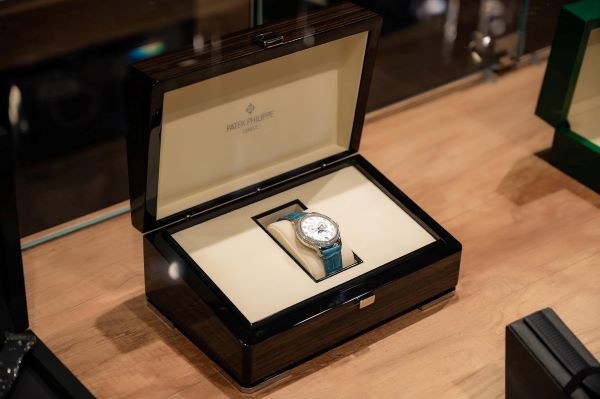
- Box: A genuine Patek Philippe box is made from premium materials (wood, real leather, or high-quality synthetics), is very sturdy and heavy, with meticulously finished details from the hinges to the interior lining. The logo and printing on the box are crisp. A fake box is often flimsy, made from cheap materials, shoddily finished, with faded logos/printing.
Compare with Images/Information from Reputable Sources
Actively seek detailed images and information about the watch model you’re interested in from trustworthy sources.
- The official Patek Philippe website (patek.com).
- Large and reputable watch forums (e.g., TimeZone, WatchUSeek).
- In-depth watch review sites with high-quality images.
Compare the details you observe on the actual watch with the reference images/information. Pay attention to the characteristic features of each collection (e.g., the integrated case design of the Nautilus, the elegant style of the Calatrava, the rounded bezel of the Aquanaut…).
Pay Attention to Price and Source of Sale
The principle of “you get what you pay for” is often very true for luxury watches. If a Patek Philippe watch is offered at a suspiciously low price compared to its general market value (whether new or pre-owned), that’s a major red flag indicating the possibility of it being a fake.
Movement Sound (Advanced)
For experienced individuals, the sound emitted by the movement can also be a clue. A genuine Patek Philippe movement operates extremely smoothly, and the ticking sound (if audible) is very soft, crisp, and consistent. Some fake movements, especially cheaper ones, may produce a louder, coarser, or irregular sound.
Lume Test in the Dark (Advanced)
As mentioned in the dial section, charge the lume (expose it to strong light for a while) then take it into a dark room. The lume on an authentic watch will glow strongly, evenly across all elements (hands, indices), and retain its glow for a relatively long time. Fake lume often glows weakly, unevenly, blotchily, with incorrect colors, or fades very quickly.
Frequently Asked Questions (FAQ)
1. How can I check a Patek Philippe serial number online?
Currently, Patek Philippe does NOT provide any public tool on its website for users to look up serial numbers to authenticate watches. The most accurate way to use a serial number is to match the number engraved on the movement with the number recorded on the Certificate of Origin that comes with the watch when purchased new from an authorized dealer.
2. How much does a fake/replica Patek Philippe watch cost?
Prices vary widely. Low-quality fakes might cost only a few tens to hundreds of dollars. High-end replica watches (Super Fake, Rep 1:1, Clone) are significantly more expensive, typically ranging from about $600 to $1,500 for common steel or plated models. More complex versions, or those using materials like solid 18k gold or Moissanite diamonds, can go up to several thousand dollars. However, this price is still only a fraction of the value of a genuine watch.
3. Where can I buy a Patek Philippe Rep 1:1 watch?
There are many places selling Patek Philippe Rep 1:1 watches on the market, both online and offline. However, the quality and reputation of sellers vary greatly. You need to research thoroughly, check reviews, actual product images/videos, and warranty policies before purchasing. Zuli Watch is one address you can consider, specializing in providing high-quality replica watches with dedicated consultation.
4. How does Patek Philippe Seal differ from Geneva Seal?
Both are top-tier quality certifications in the Swiss watch industry. The Geneva Seal (Poinçon de Genève) is an independent, long-standing standard applied to movements manufactured and assembled in the Canton of Geneva, primarily focusing on the technical and finishing criteria of the movement. The Patek Philippe Seal, introduced by the brand in 2009 to replace the Geneva Seal on its watches, is an even stricter internal quality standard. It evaluates not only the movement but also the case, dial, hands, and the accuracy of the complete watch, committing to superior overall quality throughout the product’s lifespan.
Conclusion
Distinguishing between a genuine and a fake Patek Philippe watch demands meticulous attention, knowledge, and sometimes experience. We hope that with the more than 10 detailed inspection methods shared by Zuli Watch, you now have useful information to feel more confident when approaching these exceptional timepieces, avoiding unnecessary risks, and best protecting your investment.
If you have any other questions or would like to share your own experiences in checking Patek Philippe watches, don’t hesitate to leave a comment below. And if you found this article helpful, please share it with your friends and family! Zuli Watch is always ready to accompany your passion for watches.


